Comparisons
Salesforce vs HubSpot CRM for Enterprise: The 2026 Comparison
Salesforce vs HubSpot for enterprise CRM in 2026: verified list pricing for the renamed Salesforce editions, how Agentforce and HubSpot Credits are actually billed, onboarding fees, and a clear decision framework.
Last updated: November 2026. All pricing verified against Salesforce’s official Sales Cloud pricing page and HubSpot’s Sales Hub pricing page on 3 November 2026. Both vendors changed their pricing and packaging during 2026 — if you have an older quote or an older comparison article, the numbers in it are probably wrong.
Here’s the uncomfortable truth about the Salesforce vs HubSpot debate: both are excellent enterprise CRMs. The question isn’t which one is better. The question is which one is right for your organization — and that answer is less obvious than the vendor marketing will tell you.
Most enterprise buyers make the same mistake: they either default to Salesforce because “that’s what enterprises use” (often the wrong call), or they dismiss HubSpot as a startup tool (it grew up a lot).
This breakdown is built from both vendors’ current published pricing and packaging, plus public review data from G2. Where a number isn’t publicly verifiable — and in enterprise CRM, a lot of the interesting numbers aren’t — this article says so rather than inventing one.

Quick Verdict
Salesforce wins for: Enterprises with 500+ users, complex territory management, deep ERP integrations, maximum customizability, and teams with a dedicated Salesforce Administrator.
HubSpot wins for: Companies wanting faster implementation, lower total cost of ownership, unified marketing and sales in one platform, and organizations running inbound or product-led growth motions.
The bottom line: If you’re a 50–500 person company debating these two, start with HubSpot. You can always graduate to Salesforce when you hit its ceiling. The reverse migration — ripping out Salesforce to implement HubSpot — happens more often than any CRM vendor will admit publicly.
How We Evaluated
We scored both platforms across six criteria that enterprise buyers consistently say matter most when choosing a CRM:
- Pricing and Total Cost of Ownership — list price plus implementation, training, and ongoing admin costs
- Core CRM Features — contact management, pipeline tracking, forecasting, reporting
- AI Capabilities — lead scoring, deal intelligence, autonomous agents, and crucially how they’re metered
- Ease of Use and Time to Value — onboarding speed, admin burden, adoption
- Integrations and Ecosystem — native connectors, marketplace depth, API flexibility
- Enterprise Support — SLAs, dedicated CSMs, training resources
Side-by-Side Comparison (November 2026)
| Category | Salesforce Sales Cloud | HubSpot Sales Hub |
|---|---|---|
| Enterprise starting price | $195/user/month (Core, billed annually) | From $150/seat/month (Enterprise) |
| Mid tier | Pro Suite $100/user/month | Professional $90/seat/month annual, $100 monthly |
| Mandatory onboarding fee | None from Salesforce (SI implementation priced separately) | $3,500 (Enterprise) / $1,500 (Professional) — one-time, required |
| Free tier | Free Suite listed at $0; 30-day trial on all editions | Yes — free for up to 2 users, no time limit |
| AI packaging | Agentforce included in every edition with Flex Credits (Core 500K, Advanced 1M, Max 2.75M per org/year); optional unmetered add-on from $125/user/mo | HubSpot Credits included per tier (Starter 500, Pro 3,000, Enterprise 5,000 per month); overage $0.010/credit |
| Custom objects | Yes, with per-edition limits | Enterprise tier only |
| App marketplace | 13,000+ solutions (AppExchange, now branded AgentExchange) | 2,000+ apps (HubSpot App Marketplace) |
| Territory management | Advanced, rule-based (built-in) | Basic |
| Marketing platform included | No — separate Marketing Cloud product | Yes — Marketing Hub available in the same suite |
| G2 rating (Nov 2026) | 4.4/5 (27,585 reviews) | 4.4/5 (14,383 reviews) |
Salesforce Sales Cloud: Deep Dive
Salesforce has been selling cloud CRM since 1999, and it remains the market leader by revenue — and the dominant choice for Fortune 500 enterprise sales operations. But “market leader” doesn’t automatically mean “right choice for you.”
Salesforce Pricing (November 2026)
Important: Salesforce has renamed its editions. If you’ve been quoted “Enterprise” or “Unlimited,” those names no longer exist on the current pricing page. Salesforce’s own FAQ states: “Core replaces Enterprise Edition, Advanced replaces Unlimited Edition, and Max replaces Agentforce 1 Edition.”
- Free Suite: $0/user/month (listed in the edition comparison)
- Starter Suite: $25/user/month (billed monthly or annually)
- Pro Suite: $100/user/month (billed annually)
- Core (replaces Enterprise): $195/user/month (billed annually)
- Advanced (replaces Unlimited): $395/user/month (billed annually)
- Max (replaces Agentforce 1): $550/user/month (billed annually)
The packaging change matters as much as the names. Salesforce now states that “Agentforce, Slack, Tableau, Data 360 and Premier Success are now included in every edition” — bundling that previously meant separate line items. If you are comparing a 2025 quote to a 2026 one, you are not comparing like for like.
Prices verified from the Salesforce Sales Cloud pricing page, November 2026.
Core CRM Features
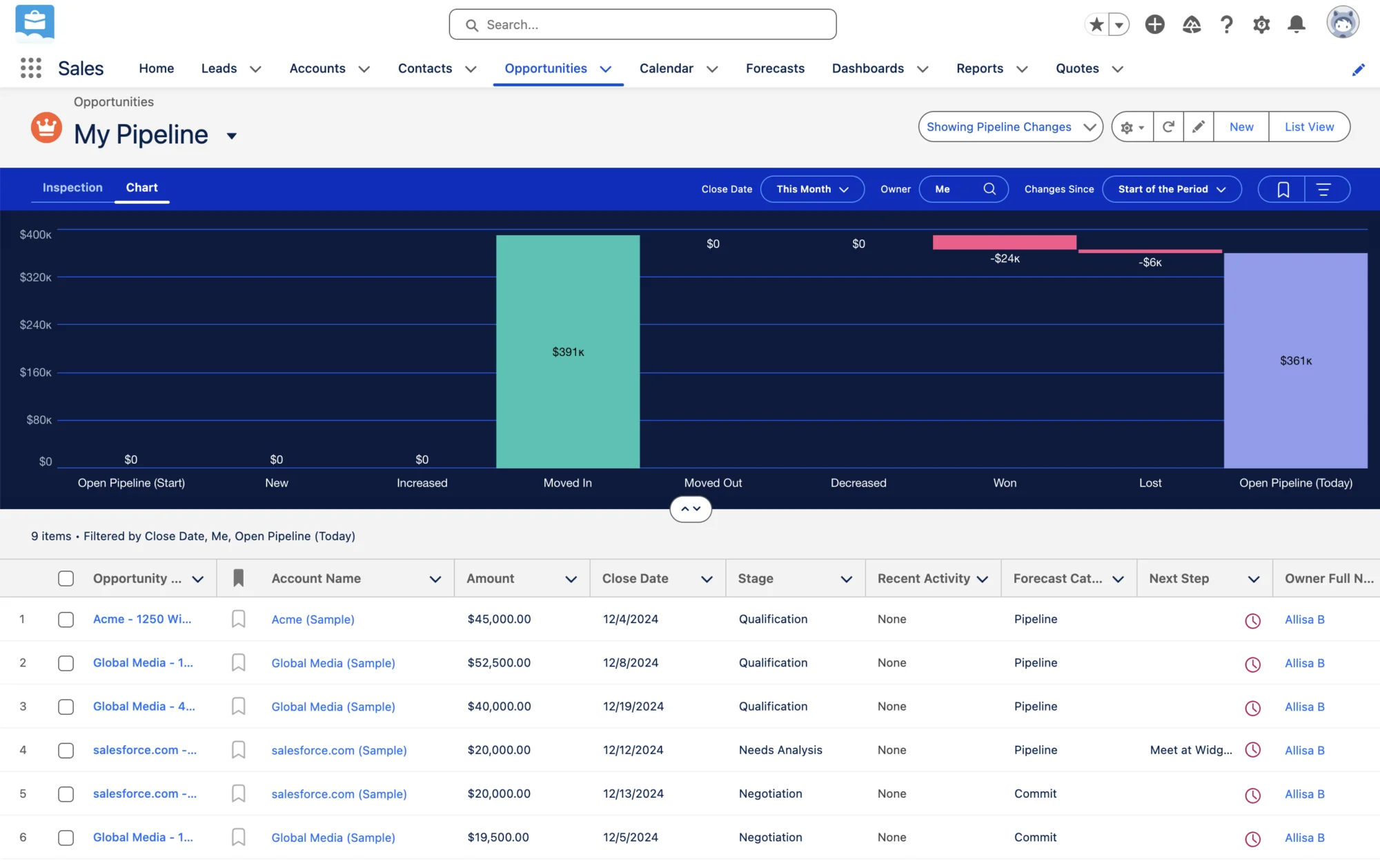
Salesforce is the Swiss Army knife of enterprise CRM. Opportunity management, account hierarchies, territory management, multi-currency, multi-language, complex approval workflows — it handles all of it, and handles it deeply.
The capabilities that make Salesforce the default for complex sales organizations:
- Territory management: Rule-based territory assignment at scale — essential for companies with hundreds of reps across regions, products, or verticals
- Account hierarchies: Track parent and subsidiary relationships across global enterprise accounts
- Custom objects: Model almost any business process or data structure. Note that custom object allowances are capped per edition rather than unlimited — confirm the limit for the edition you’re buying, because it’s a common source of mid-implementation surprises
- Advanced collaborative forecasting: Pipeline inspection, scenario planning, and multi-currency rollups
- Salesforce Shield: Enhanced security, platform encryption, and compliance for regulated industries
The catch: every one of these features requires configuration. Salesforce out of the box is like receiving a fully equipped machine shop with no manual. The tools are there — someone has to set them up.
AI: Einstein and Agentforce

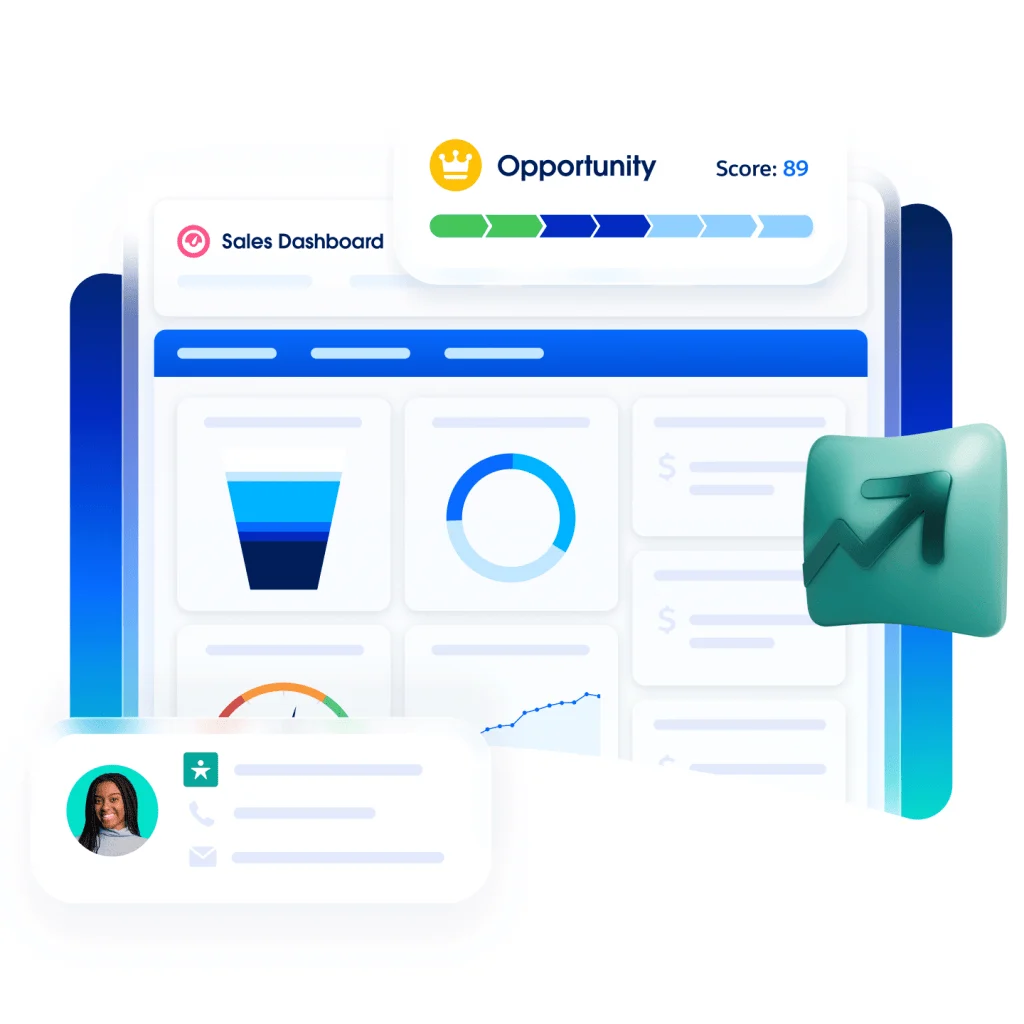
Einstein delivers predictive lead scores, deal health scores, and conversation insights pulled from emails and calls. Agentforce — Salesforce’s autonomous AI agent layer — can handle inbound lead qualification, prospect research, and handoff to human reps without manual intervention.
How Agentforce is actually billed, as of November 2026. This changed, and it changed in a way that undercuts a lot of older comparison articles. Agentforce is now included in every Sales Cloud edition, metered by Flex Credits: roughly 500,000 credits per org per year on Core, 1 million on Advanced, and 2.75 million on Max. Flex Credits are sold at $500 per 100,000 credits (about $0.005 per credit), and Salesforce estimates roughly 20 credits — about $0.10 — per agent action. On top of that, there is an optional unmetered Agentforce for Sales add-on from $125/user/month for teams whose usage would blow through the credit pool.
So the old framing — “Salesforce AI costs $125/user/month extra, HubSpot’s is free” — is no longer accurate. Both vendors now meter AI. The real question is whether your expected agent volume fits inside the included credits on either side.
One caveat that hasn’t changed: extracting meaningful AI predictions requires clean historical data, which most organizations don’t have in the first 12–18 months of any CRM deployment. Budget for the data cleanup, not just the AI subscription.
Ease of Use and Implementation
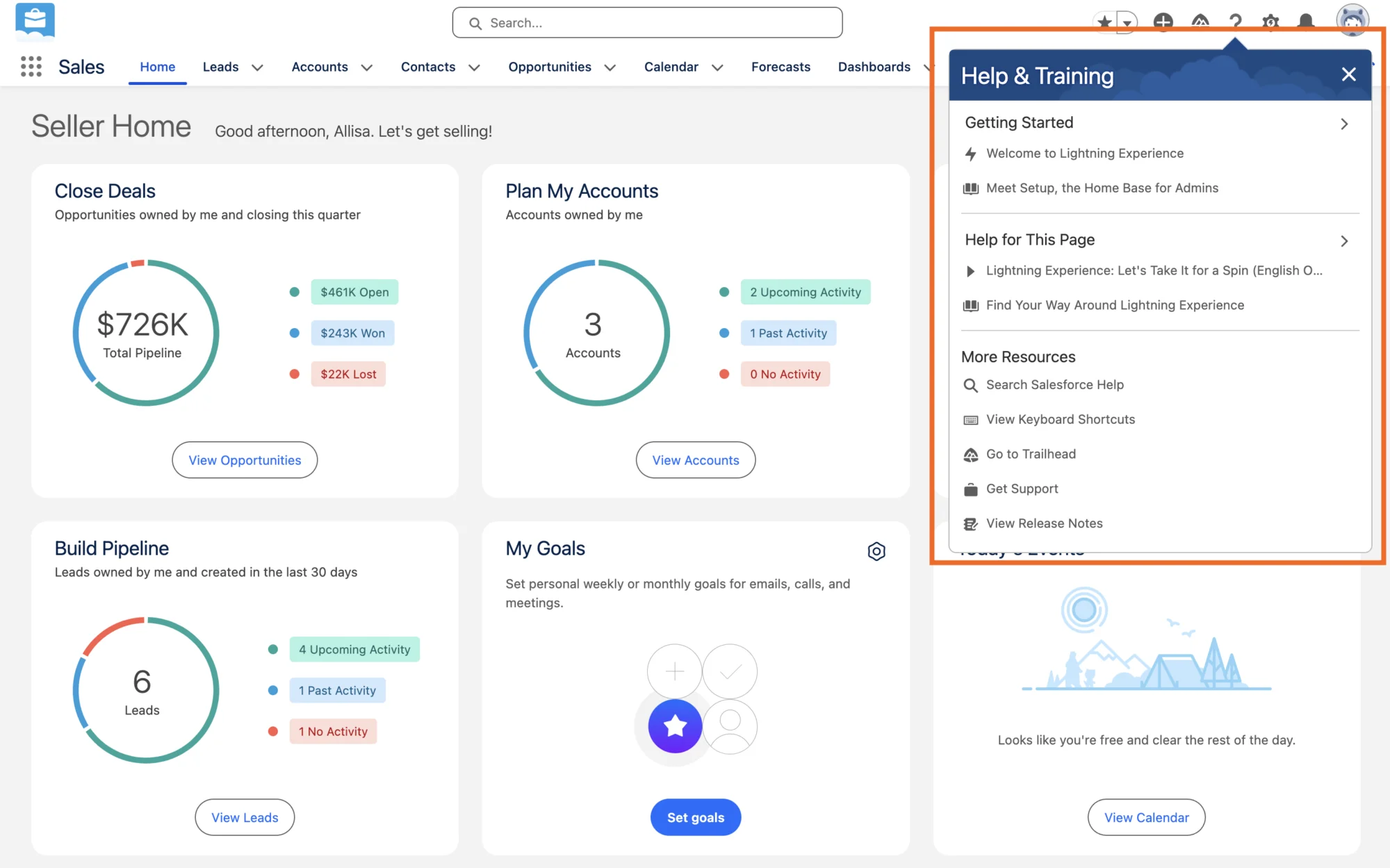
Salesforce has a steep learning curve. G2 reviewers consistently rate it lower on ease of use and ease of setup than HubSpot, and enterprise implementations commonly run for months with a systems integrator partner. The Trailhead training platform is genuinely excellent — Salesforce Administrators have become a profession for a reason. Once certified, your admin can build virtually anything. But “can build anything” is not the same as “anyone can use it on day one.”
Integrations and AppExchange
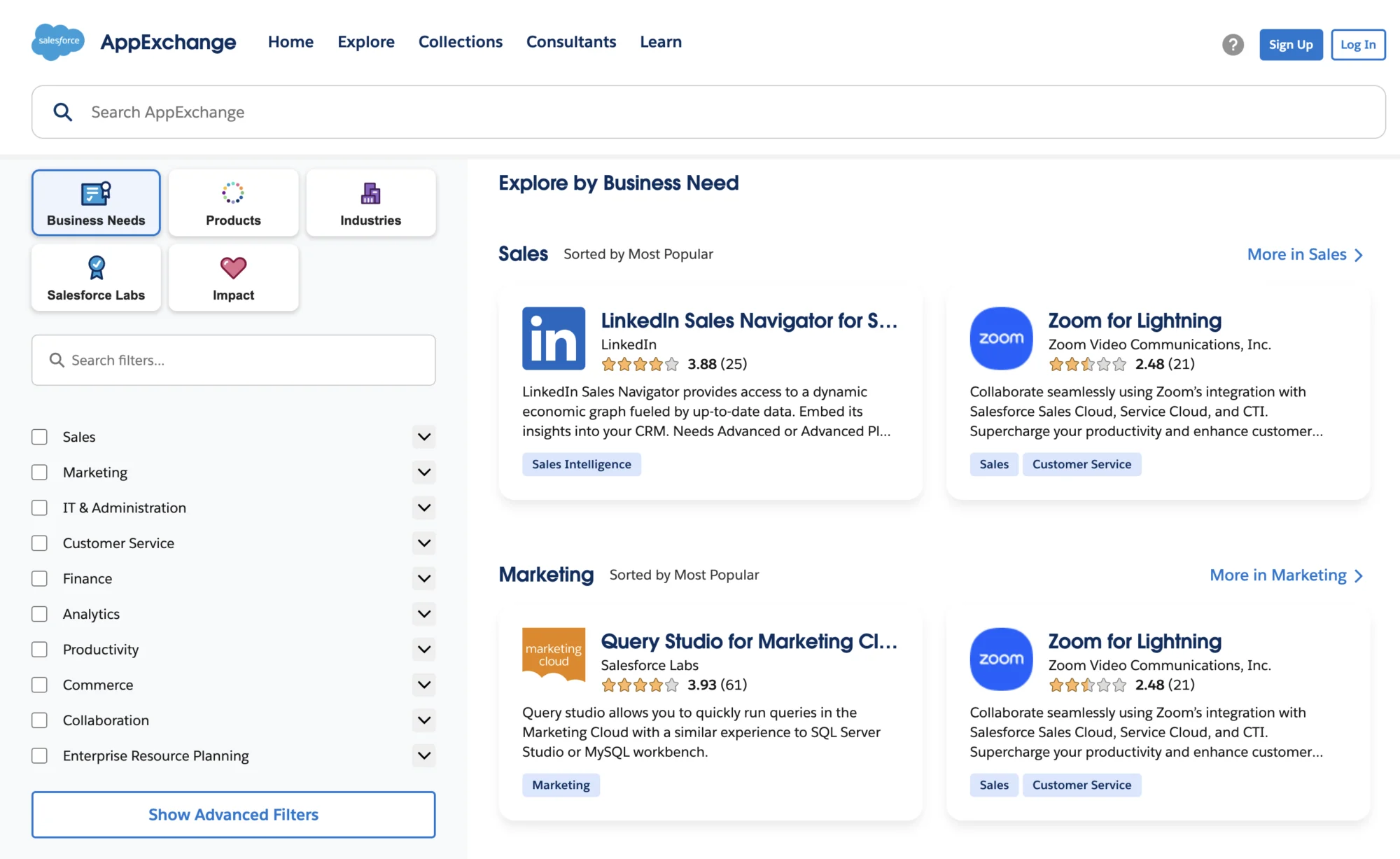
The marketplace lists more than 13,000 solutions, backed by over 187,000 customer reviews, and has been rebranded from AppExchange to AgentExchange. Every major enterprise software vendor — SAP, Oracle, Workday, Snowflake — has a certified Salesforce integration. If you’re running a complex enterprise tech stack, Salesforce almost certainly has a native connector or a certified partner app.
Watch the licensing: many marketplace apps carry additional per-user fees that compound quickly across a large team. Always model the full app cost into your total cost calculation.
HubSpot Sales Hub: Deep Dive
HubSpot launched as a marketing tool. A decade ago, enterprise sales teams wouldn’t have considered it. Today it competes directly with Salesforce for 200–2,000 employee organizations — and wins more of those deals than most people realize.
HubSpot Pricing (November 2026)
- Free: $0/month, free for up to 2 users, no credit card required and no time limit
- Starter: from $7/seat/month billed annually, or $20/seat/month billed monthly (the annual rate is flagged as a new-customer discount)
- Professional: $90/seat/month billed annually, or $100/seat/month monthly — plus a required one-time $1,500 Professional Onboarding fee
- Enterprise: from $150/seat/month — plus a required one-time $3,500 Enterprise Onboarding fee
Those onboarding fees are not optional and not negotiable away in the self-serve flow — HubSpot’s pricing page states the cost shown “does not include the required, one-time” onboarding. On a 100-seat Enterprise deployment the $3,500 is a rounding error; on a 10-seat Professional rollout the $1,500 is a meaningful share of year one.
Prices verified from the HubSpot Sales Hub pricing page, November 2026.
Core CRM Features

HubSpot is built around a core principle: salespeople should spend time selling, not administering a CRM. The Prospecting Workspace puts contacts, tasks, emails, and AI recommendations into a single screen — no tab-switching required.
Enterprise-grade features available in HubSpot Sales Hub:
- Custom objects (Enterprise tier): Flexible data modeling to match your business process
- Multiple deal pipelines: Different pipelines with stage-specific automation for different product lines
- Buying groups: Map every stakeholder in a complex B2B enterprise deal
- Conversation intelligence: Call recording, transcription, and AI coaching insights
- Predictive lead scoring (Enterprise): AI-powered deal prioritization
- Deal Plans: Shared path-to-close documents your buyers can view and act on directly
Where HubSpot still falls short: territory management is basic compared to Salesforce, multi-currency reporting is less mature, and very large data sets can show performance degradation.
AI: Copilot, Agents and the Credit Model
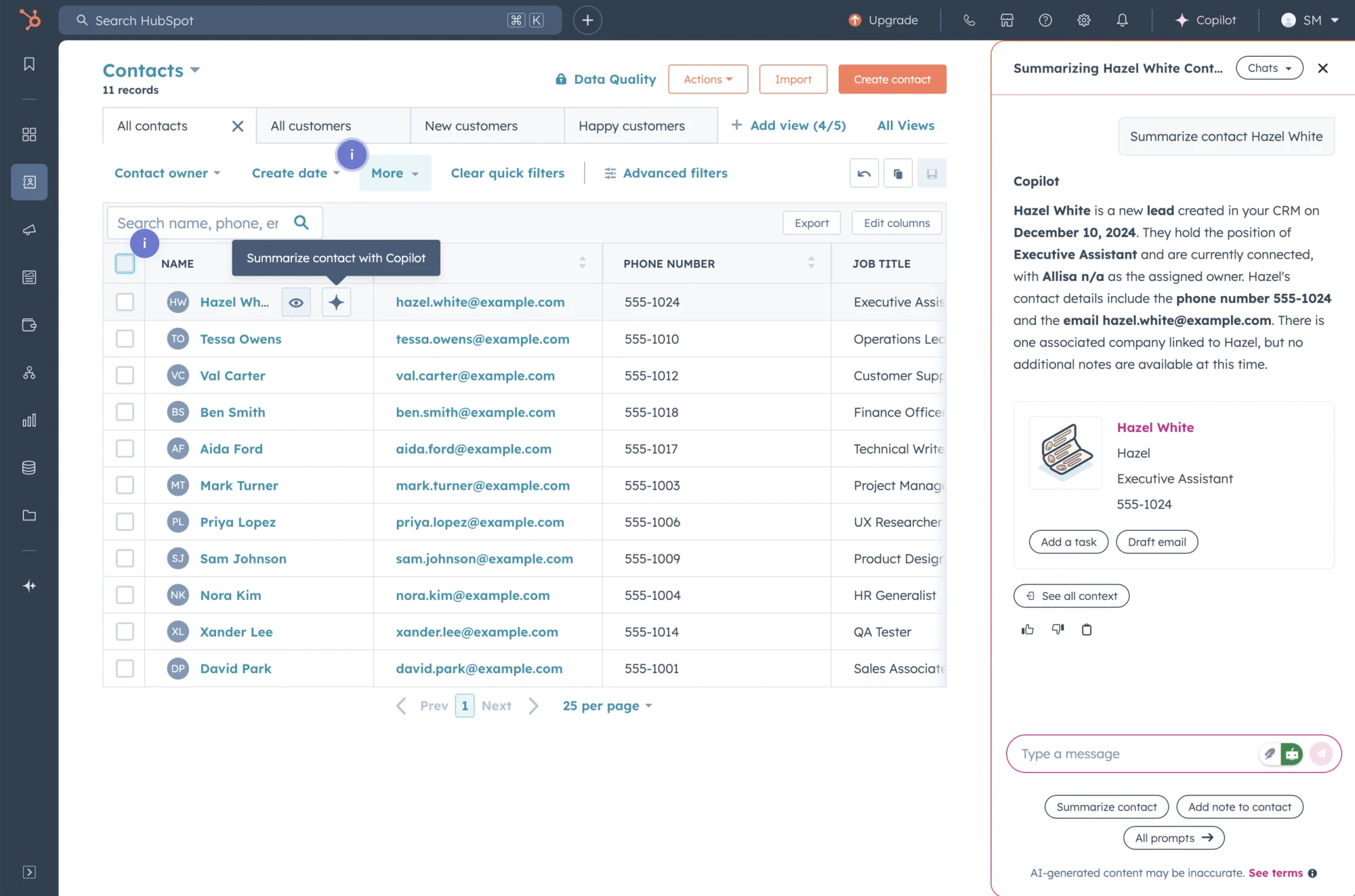
HubSpot’s AI layer runs throughout the platform: a prospecting agent that researches accounts, surfaces buying contacts and drafts personalized outreach, plus a copilot handling email drafting, meeting summaries and CRM data updates.
The billing model changed here too, and the change matters. HubSpot’s AI is metered by HubSpot Credits, with a monthly allotment per tier: 500 on Starter, 3,000 on Professional, 5,000 on Enterprise. Credits are consumed whenever AI features take action across the platform, reset monthly, do not roll over, and are not additive across products — you get the highest allotment among your subscriptions, not the sum. Additional credits cost $0.010 each, sold in packs or pay-as-you-go. The current pricing page also files these capabilities under Agent Hub rather than the older Breeze branding.
Practical implication: “AI included” on both platforms means “a usage allowance included.” For a heavy-usage sales team, model the credit burn on both sides before treating AI as a cost differentiator in either direction.
Ease of Use — HubSpot’s Real Competitive Moat
HubSpot’s biggest competitive advantage isn’t any individual feature. It’s that sales teams actually use it.
This shows up consistently in public review data: HubSpot outscores Salesforce on ease of use, ease of setup and ease of admin on G2, despite near-identical overall ratings (both sit at 4.4/5). Adoption is where CRM programs quietly fail — a CRM your reps avoid produces a pipeline view you can’t trust, and a bad pipeline view costs more than the licence difference.
Be sceptical of precise adoption statistics in vendor-adjacent content, including the widely repeated claims that HubSpot hits 80% adoption in 60 days or that Salesforce stalls at 50%. Those figures circulate widely without a traceable primary source. The directional point — simpler interface, higher voluntary usage — is well supported by review data; the specific percentages are not.
Integrations and App Marketplace
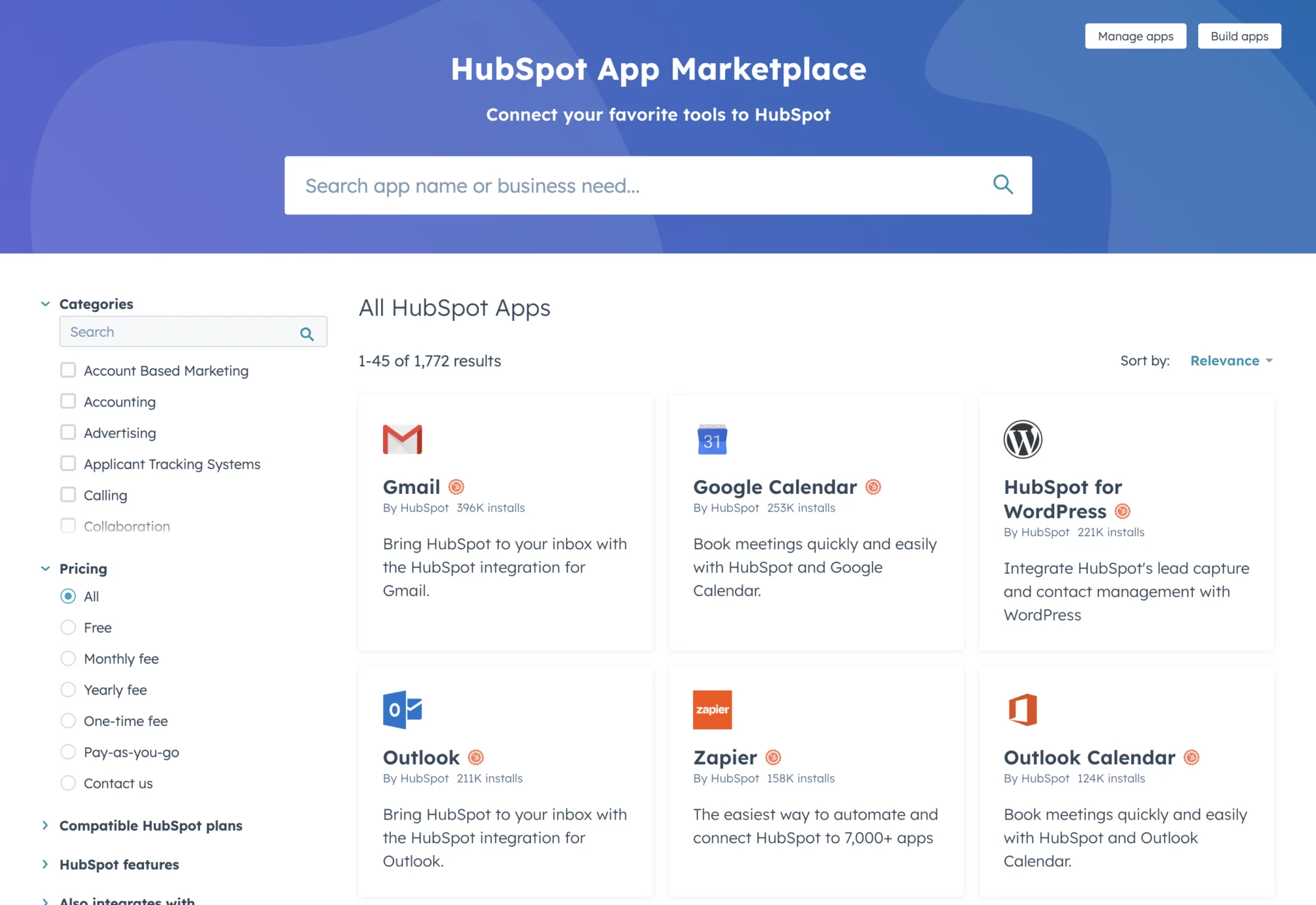
HubSpot’s marketplace advertises over 2,000 apps and web services — robust for the majority of enterprise use cases, though well short of Salesforce’s 13,000+. The critical question is whether your specific tech stack needs a connector that only Salesforce’s marketplace offers. Deep SAP, Oracle, and Workday integrations still tend to be more mature on the Salesforce side.
One underrated advantage: HubSpot’s suite spans marketing, content and service alongside sales. For organizations looking to consolidate martech, HubSpot can replace several separate point solutions — a real cost benefit that pure-CRM price comparisons miss.
Sales Analytics and Reporting
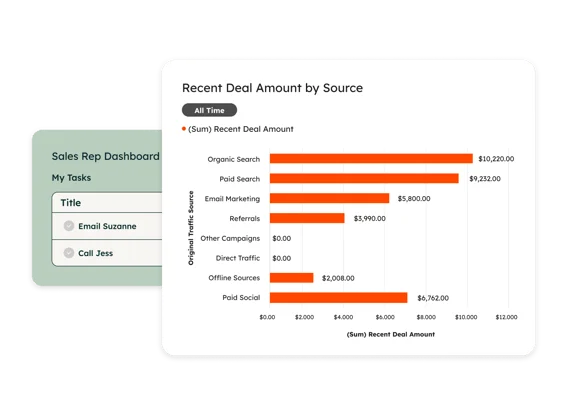
HubSpot’s reporting has improved substantially. Custom report builder, cross-object analytics, and revenue attribution are available at Enterprise tier. For most enterprise reporting needs it’s sufficient — and considerably easier to configure than Salesforce’s report builder, which requires admin expertise for anything beyond basic dashboards.
What Nobody Can Tell You About Total Cost
Comparison articles love to quote total-cost-of-ownership figures: “a 100-seat Salesforce deployment runs $500K–$2M in year one,” “HubSpot is 40–70% cheaper.” You’ll see those numbers everywhere, including in earlier versions of this article. They should be treated with suspicion, because neither vendor publishes implementation cost data and the ranges are wide enough to be unfalsifiable.
What you can verify, and what actually drives the gap:
- Licence cost is the easy part. 100 seats on Salesforce Core is $195 × 100 × 12 = $234,000/year at list. 100 seats on HubSpot Enterprise is $150 × 100 × 12 = $180,000/year at list, plus the one-time $3,500 onboarding. Both are heavily discounted at enterprise volume, so treat list price as a ceiling, not a forecast.
- Implementation is where the variance lives. Salesforce deployments typically involve a systems integrator; HubSpot deployments typically don’t. That single structural difference, not the licence line, is what produces the dramatic TCO spreads you see quoted.
- Admin headcount is a recurring cost. A dedicated Salesforce Administrator is a standard role with a market salary. HubSpot more often gets administered by an existing ops person part-time. Price that against your own org chart rather than a generic benchmark.
- AI credits are now a real line item on both sides. See the credit models above and estimate your own agent volume.
If you need a defensible internal number, build it from your own seat count, your own integration list, and quotes from two implementation partners. HubSpot publishes a TCO calculator, which is useful as a structure for the exercise — while remembering that it is a vendor tool, built by the party with an interest in the answer.
Which One Should You Choose?
Choose Salesforce Sales Cloud if you:
- Have 500+ sales reps across multiple territories or global regions
- Need complex rule-based territory management and quota distribution
- Require deep integrations with enterprise ERP systems (SAP, Oracle, Workday)
- Have — or are budgeting for — a dedicated Salesforce Administrator
- Operate in regulated industries requiring Salesforce Shield compliance tools
- Have a multi-month runway for implementation before go-live pressure
Choose HubSpot Sales Hub if you:
- Have 50–500 sales reps and need to be live and productive within weeks, not months
- Want marketing and sales on a single unified platform with shared contact data
- Are prioritizing CRM adoption over CRM feature completeness
- Need to control total cost of ownership against a Salesforce deployment budget
- Run inbound, content-led, or product-led growth sales motions
- Don’t have budget for a dedicated CRM administrator or an SI implementation partner
Final Verdict
Salesforce is the enterprise CRM standard for a reason. If your organization has 500+ seats, global territory complexity, deep ERP integration requirements, and an admin team to run it, Salesforce’s customizability and 13,000-strong marketplace are unmatched. No CRM on the market matches its depth for genuinely complex enterprise sales operations.
HubSpot has closed the enterprise gap. For the 50–500 employee range — or any organization that has watched a Salesforce implementation stall on adoption — HubSpot delivers competitive depth at a lower licence cost and with faster time to value. The built-in marketing platform is an advantage Salesforce’s separate cloud products can’t replicate without additional spend.
The honest verdict: If you’re at 100 people asking “Salesforce or HubSpot?” — start with HubSpot. You can always migrate when you hit the ceiling. Moving from HubSpot to Salesforce as you scale is a manageable, planned project. Ripping out a misconfigured Salesforce implementation to start over on HubSpot is expensive, painful, and more common than the sales cycle suggests.
And whichever way you lean, re-verify the pricing yourself before you sign. Both vendors restructured their editions and their AI billing during 2026, and most of what’s written about this comparison online still describes the old packaging.
Frequently Asked Questions
Is Salesforce better than HubSpot for enterprise?
Salesforce wins for large enterprises needing deep customization, complex territory management, and access to a 13,000+ app marketplace. HubSpot wins for companies prioritizing ease of use, faster implementation, and lower total cost of ownership — especially those with strong inbound marketing operations running alongside their sales motion.
How much does Salesforce cost for enterprise in 2026?
As of November 2026, Salesforce Sales Cloud’s enterprise-grade editions are Core at $195/user/month, Advanced at $395/user/month, and Max at $550/user/month, all billed annually. Salesforce renamed these tiers: Core replaces the old Enterprise edition, Advanced replaces Unlimited, and Max replaces Agentforce 1. Implementation through a systems integrator is priced separately and is not published by Salesforce.
How much does HubSpot enterprise CRM cost in 2026?
HubSpot Sales Hub Enterprise starts at $150/seat/month, plus a required one-time $3,500 onboarding fee. Professional is $90/seat/month billed annually ($100 monthly), plus a required one-time $1,500 onboarding fee. Starter begins at $7/seat/month on annual billing for new customers, and the free tier covers up to 2 users.
Can HubSpot replace Salesforce?
HubSpot can replace Salesforce for mid-market and enterprise companies with fewer than 500 employees, straightforward sales processes, or inbound marketing-led growth motions. For 500+ seat deployments with complex territory management, multi-currency reporting across dozens of countries, or deep ERP integrations, Salesforce remains the stronger choice.
Which CRM has better AI features: Salesforce or HubSpot?
Salesforce leads on AI depth with Einstein predictive scoring and Agentforce autonomous agents, and as of 2026 Agentforce is included in every Sales Cloud edition with an annual Flex Credit allowance (500,000 on Core, 1 million on Advanced, 2.75 million on Max), plus an optional unmetered add-on from $125/user/month. HubSpot’s AI is included per tier as HubSpot Credits — 500 on Starter, 3,000 on Professional, 5,000 on Enterprise each month, with overage at $0.010 per credit. Both are metered, so the right comparison is your expected usage against each allowance rather than one being “free.”
Did Salesforce rename its pricing tiers?
Yes. Salesforce’s current pricing page lists Starter Suite, Pro Suite, Core, Advanced and Max. Its FAQ states that Core replaces Enterprise Edition, Advanced replaces Unlimited Edition, and Max replaces Agentforce 1 Edition. The older “Einstein 1 Sales” name no longer appears. Salesforce also now bundles Agentforce, Slack, Tableau, Data 360 and Premier Success into every edition, so older quotes are not directly comparable to current ones.